Commit-confirm#
Commit-confirm applies a change and starts a timer on the router at the same moment. If a confirmation arrives before the timer runs out, the change is permanent. If it does not, the router reboots into the previous configuration. That reboot is the rollback — it is how the router's own configuration backend implements the feature, and it is what makes a change to a firewall rule, an uplink address or the SSH service survivable when you are the far side of it.
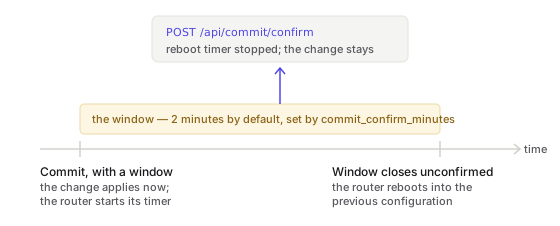
The mechanism#
It is the router's, not the agent's. The agent posts the working set with a
confirm_time field, and posts an op: "confirm" to cancel:
R=https://<router>:8443
T=wh_...                                  # an API token with the operator role

curl -sk -X POST "$R/api/commit" -H "Authorization: Bearer $T" \
  -d '{"confirm_minutes":2}'
# {"success":true,"committed":3,"confirm_minutes":2,"awaiting_confirm":true}

curl -sk -X POST "$R/api/commit/confirm" -H "Authorization: Bearer $T"
# {"success":true}
Underneath, those become one request each to the router's /configure endpoint —
{"commands": [...], "confirm_time": 2} and {"op": "confirm"}
(agent/vyos.go, ConfigureConfirm and Confirm). Both have
to travel as a JSON body: the form encoding the router also accepts cannot carry
confirm_time, and its form parser rejects an operation with no path, which
confirm has. That is recorded, with the date it was verified on the bench, in
docs/api-cookbook.md, along with the router's answers —
Initialized commit-confirm; 2 minutes to confirm before reboot, then Reboot timer
stopped.
The window comes from the agent's settings, commit_confirm_minutes, default 2
(agent/store.go, defaultSettings). An admin can change it
under Administration → Agent settings.
What the browser does with it#
When a commit comes back with awaiting_confirm, the Commit Bar is replaced by a
countdown that outranks everything else on the screen: a draining progress bar, the
time left, and one sentence of reasoning —
If you can still read this page, the change worked. Confirm to keep it — otherwise the router reboots into the previous config.
That sentence is the whole test. You are being asked to prove connectivity by using
it. Two buttons sit beside it
(ui/src/components/CommitBar.tsx):
- Confirm & keep changes posts
/api/commit/confirm. A failure — the window already confirmed from a terminal, the router unreachable — is shown in the countdown rather than disappearing. - Dismiss hides the countdown and nothing else.
The countdown in the browser is the browser's arithmetic — the moment the commit returned, plus the window. It is an indicator of the router's timer, not the timer itself. Confirm with time to spare.
What the failure path actually costs#
A reboot, in full. Not a silent revert:
- Every session on the router drops, including yours and any SSH.
- Containers stop and come back as the restored configuration declares them — see Apps are configuration.
- Uptime resets, and the boot takes as long as that hardware takes.
- The change is gone. The configuration that comes back is the one that was running before the commit.
That is the trade, and it is worth stating plainly to anyone about to press the button: the safety property is real because the recovery is drastic. A router in a rack recovers by itself; a router you are about to walk away from should be confirmed first.
When to use it#
The Commit Bar offers commit-confirm on every commit, and flags the sets that most warrant it — the rule is on The Commit Bar. Use it whenever the change is in the path between you and the router:
- firewall rules and zone policy;
- NAT, including the rules that publish a service;
- an interface address, especially on the uplink;
- the default route, failover, load balancing or policy routing;
service ssh,service httpsand the router's API service;- anything touching certificates or accounts.
The reconcile loop uses the same mechanism when it is running in commit mode: it
commits with a --reconcile-confirm window (default 2 minutes) and confirms only once
the router still answers, so a change that cut the agent off is left to roll back on
its own — agent/desired.go, applyCommit.
Commit-confirm and rollback are different tools#
| Commit-confirm | Rollback | |
|---|---|---|
| When you decide | Before the commit | After it |
| What triggers the undo | A timer expiring | You, deliberately |
| How the undo happens | The router reboots into the previous configuration | An archived revision is loaded and committed |
| Needs the router reachable | No — that is the point | Yes |
| Costs a reboot | Yes, on the failure path | No |
Use commit-confirm when the change might cost you the connection. Use rollback when the change worked, was committed, and turned out to be wrong.
See also#
- The Commit Bar — where the button lives and what it flags.
- Revisions and rollback — the other undo.
- Staging: the working set — what gets committed.
- Recovering from a lockout — when the window closed and you are still outside.
- Rolling back a change.
Checked against#
agent/main.go ·
agent/vyos.go ·
agent/store.go ·
agent/desired.go ·
ui/src/components/CommitBar.tsx ·
ui/src/lib/staging.tsx ·
docs/api-cookbook.md ·
docs/deploy.md